
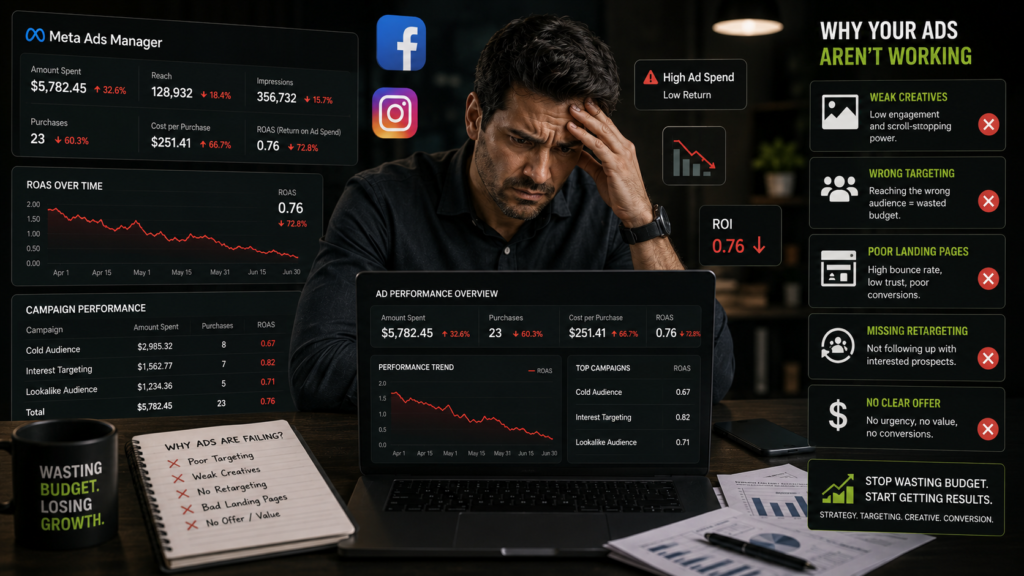
Running Meta Ads But Getting No Results? You’re Probably Making These 5 Mistakes
Running Meta Ads can feel exciting at first. You launch a campaign, set your budget, and wait for leads or sales to start pouring in. But then reality hits — clicks are expensive, conversions are low, and your return on investment feels almost nonexistent.
If that sounds familiar, you’re not alone.
Many business owners spend thousands on Meta Ads without understanding why their campaigns fail. The good news? Most underperforming campaigns suffer from a few common mistakes that can be fixed with the right strategy.
In this guide, we’ll break down the five biggest Meta Ads mistakes businesses make and show you how to turn wasted ad spend into profitable campaigns.
Many businesses struggle because of common Meta Ads mistakes that reduce conversions and increase wasted ad spend. Understanding these Meta Ads mistakes can help improve targeting, creatives, landing pages, and overall campaign performance.
Why Meta Ads Fail for Many Businesses
Meta platforms like Facebook and Instagram still offer incredible advertising opportunities. Billions of users spend hours scrolling every day, making these platforms powerful tools for reaching customers.
However, success doesn’t happen automatically.
Many businesses assume running ads is as simple as boosting a post or selecting a random audience. Unfortunately, Meta’s advertising system has become more competitive, requiring strategic planning, optimized creatives, accurate targeting, and constant testing.
Without these elements, your budget disappears quickly.
Let’s look at the biggest reasons your Meta Ads may not be delivering results.
Mistake #1: Targeting the Wrong Audience
One of the fastest ways to waste ad spend is showing your ads to the wrong people.
Even the best-looking ad won’t perform if it reaches users who have no interest in your product or service.
Understanding Audience Intent
Not every user on Meta is ready to buy.
Some people are casually browsing, while others are actively searching for solutions. Your goal is to identify audiences most likely to take action.
For example:
- A local gym should target nearby fitness enthusiasts
- An eCommerce brand should focus on shoppers with purchase behavior
- A B2B company should reach decision-makers and business owners
If your targeting is too broad, Meta may optimize toward cheap clicks instead of qualified leads.
Broad vs Narrow Targeting
Many advertisers make one of two mistakes:
| Too Broad | Too Narrow |
|---|---|
| Reaches irrelevant people | Limits campaign scale |
| Wastes budget | Increases costs |
| Poor engagement | Delivery issues |
The key is balance.
Use interest targeting, demographics, behaviors, and audience insights together to create a focused yet scalable audience.
Using Custom & Lookalike Audiences
One of Meta’s strongest features is its advanced audience system.
Smart advertisers use:
- Website visitor retargeting
- Customer email lists
- Video viewers
- Instagram engagers
- Lookalike audiences based on existing buyers
These audiences often outperform cold targeting because they rely on real customer data.
Mistake #2: Weak Ad Creatives That Don’t Convert
You only have a few seconds to capture attention on social media.
If your creative looks boring, generic, or confusing, people scroll past instantly.
Why Creative Matters More Than Ever
Meta’s algorithm rewards engaging content. Strong creatives lower your costs and improve performance because users interact with them more frequently.
Today, successful ads feel less like advertisements and more like native social content.
Common Creative Mistakes
Businesses often use:
- Low-quality graphics
- Stock images
- Too much text
- Generic headlines
- Weak calls-to-action
- Overly sales-focused messaging
These mistakes reduce trust and hurt click-through rates.
One of the most damaging Meta Ads mistakes is using weak creatives that fail to capture attention or drive engagement.
How to Create Scroll-Stopping Ads
Great Meta Ads usually include:
1. Strong Hooks
Your first sentence should grab attention immediately.
Example:
- “Still wasting money on Facebook Ads?”
- “Why are your Instagram Ads not converting?”
2. Clear Benefits
Focus on outcomes, not features.
Instead of:
- “We offer digital marketing services.”
Say:
- “Generate more qualified leads without increasing ad spend.”
3. Authentic Visuals
User-generated content, testimonials, and behind-the-scenes videos often outperform polished corporate ads.
4. Clear CTA
Tell users exactly what to do next:
- Book a call
- Shop now
- Get a free audit
- Learn more
Mistake #3: Ignoring Retargeting Campaigns
Many businesses only run cold traffic campaigns and ignore retargeting completely.
That’s a huge mistake.
What Is Retargeting?
Retargeting allows you to show ads to people who already interacted with your business.
Examples include users who:
- Visited your website
- Watched your videos
- Added products to cart
- Engaged with Instagram posts
- Opened lead forms
These audiences are warmer and more likely to convert.
Ignoring retargeting is among the most common Meta Ads mistakes businesses make when trying to scale campaigns profitably.
Why Retargeting Increases ROI
Most customers don’t buy immediately.
People often need multiple touchpoints before making a decision. Retargeting keeps your brand visible and builds trust over time.
In many cases, retargeting campaigns deliver:
- Lower cost per lead
- Higher conversion rates
- Better return on ad spend
- Increased brand recall
Best Retargeting Strategies
Successful businesses use layered retargeting campaigns such as:
| Audience Type | Strategy |
|---|---|
| Website visitors | Show testimonials |
| Cart abandoners | Offer limited-time discounts |
| Video viewers | Share product demos |
| Existing customers | Upsell related offers |
Retargeting is often where the highest ROI comes from.
Mistake #4: Sending Traffic to Poor Landing Pages
Sometimes the problem isn’t the ad — it’s the page users land on afterward.
You can drive thousands of clicks, but if your landing page is slow, confusing, or unconvincing, conversions will stay low.
Ad-to-Page Message Match
Your landing page must continue the same message as your ad.
If your ad promises:
- “Free Consultation”
Your landing page should immediately reinforce that offer.
When users see mismatched messaging, trust drops instantly.
Poor landing page experiences are serious Meta Ads mistakes that reduce trust and increase bounce rates.
Slow Load Speed Problems
Modern users are impatient.
If your page takes too long to load:
- Visitors leave
- Bounce rates increase
- Conversion rates drop
- Ad costs rise
Mobile optimization is especially important because most Meta traffic comes from smartphones.
Optimizing Landing Pages for Conversion
High-converting landing pages usually include:
- Clear headlines
- Fast loading speed
- Strong social proof
- Testimonials
- Simple forms
- Clear CTA buttons
- Minimal distractions
Every extra step reduces conversions.
Keep the experience smooth and focused.
Mistake #5: Not Tracking or Optimizing Campaigns Properly
Launching a campaign without tracking is like driving blindfolded.
You cannot improve what you don’t measure.
Importance of Meta Pixel
The Meta Pixel helps track:
- Purchases
- Leads
- Page views
- Add-to-carts
- User behavior
Without proper tracking, Meta struggles to optimize campaigns effectively.
Many advertisers continue making Meta Ads mistakes by running campaigns without proper tracking or performance analysis.
Key Metrics to Monitor
Business owners often focus only on clicks, but clicks alone don’t guarantee sales.
Instead, monitor:
| Metric | Why It Matters |
|---|---|
| CTR | Measures engagement |
| CPC | Controls cost efficiency |
| ROAS | Tracks profitability |
| Conversion Rate | Measures landing page effectiveness |
| Frequency | Prevents ad fatigue |
A/B Testing for Better Performance
Top-performing advertisers constantly test:
- Headlines
- Creatives
- Audiences
- CTAs
- Ad formats
Even small changes can dramatically improve results.
Testing helps identify what truly works instead of relying on assumptions.
How Successful Businesses Scale Meta Ads
Businesses that consistently succeed with Meta Ads follow a structured strategy.
They:
- Use accurate audience targeting
- Create engaging creatives
- Retarget warm audiences
- Optimize landing pages
- Analyze campaign data regularly
Most importantly, they treat advertising as an ongoing optimization process — not a one-time setup.
Signs You Need Professional Meta Ads Management
If you’re experiencing any of these issues, it may be time to get expert help:
- High ad spend with low sales
- Poor lead quality
- Declining ROAS
- Rising CPCs
- Low conversion rates
- Inconsistent campaign performance
- No clear scaling strategy
Professional campaign management can save both time and money by avoiding costly mistakes.
Why Businesses Choose Beinfinity
Managing Meta Ads successfully requires more than simply clicking the “Boost Post” button.
At Beinfinity, businesses get:
- Advanced audience targeting
- High-converting ad creatives
- Strategic retargeting campaigns
- Landing page optimization
- Performance tracking & reporting
- Ongoing campaign optimization
Whether you’re trying to generate leads, increase online sales, or grow brand awareness, Beinfinity helps turn ad spend into measurable business growth.
Learn more about professional Meta Ads management services at Beinfinity
Frequently Asked Questions
1. Why are my Meta Ads getting clicks but no sales?
This often happens because of poor targeting, weak landing pages, or mismatched messaging between ads and offers.
2. How much should I spend on Meta Ads?
Your budget depends on your industry, goals, and competition. Start with a test budget and scale based on performance data.
3. What is the best objective for Meta Ads?
The best objective depends on your goal. For sales or leads, conversion-focused objectives usually perform best.
4. How long does it take for Meta Ads to work?
Most campaigns need several days of optimization before delivering stable results. Consistent testing improves performance over time.
5. Are boosted posts effective?
Boosted posts can increase visibility, but they usually lack the advanced targeting and optimization features available in Ads Manager.
6. Why is retargeting important in Meta Ads?
Retargeting helps reconnect with users who already showed interest in your business, increasing conversion rates and improving ROI.
7. What are the most common Meta Ads mistakes?
The most common Meta Ads mistakes include poor audience targeting, weak ad creatives, missing retargeting campaigns, slow landing pages, and lack of campaign optimization.
8. How can I avoid Meta Ads mistakes?
You can avoid Meta Ads mistakes by improving audience targeting, testing creatives regularly, optimizing landing pages, using retargeting campaigns, and monitoring campaign analytics consistently.
Avoiding Meta Ads mistakes requires continuous optimization, testing, and strategic planning. Businesses that identify and fix Meta Ads mistakes early usually achieve higher conversion rates and better long-term advertising performance.
Conclusion
Running Meta Ads without a clear strategy can quickly drain your marketing budget.
The good news is that most campaign failures come from fixable mistakes:
- Poor targeting
- Weak creatives
- Missing retargeting
- Bad landing pages
- Lack of optimization
When these issues are addressed properly, Meta Ads can become one of the most profitable marketing channels for your business.
Instead of wasting more budget on trial and error, working with experienced professionals can help you achieve faster and more sustainable growth.
If you’re ready to improve your Meta Ads performance, consider partnering with Beinfinity for expert ad management and ROI-focused campaign strategies.
Avoiding these Meta Ads mistakes is essential if you want better ROI, lower acquisition costs, and long-term advertising success.
Understanding and fixing Meta Ads mistakes can dramatically improve your campaign results. Whether the issue is targeting, creatives, retargeting, or landing pages, reducing Meta Ads mistakes is the key to maximizing ROI and scaling your business successfully.